Teach old APIs new tricks.
Agents operate your legacy system, safely.
curl -fsSL https://raw.githubusercontent.com/iml885203/lodog/main/install.sh | shPoint it at a Swagger file. Get an agent you can trust.
lodog sits between your agent and the legacy API. The old system stays exactly as it is.
Score it first
lodog score rates your spec out of 30 and lists what an agent will trip on.
Prove it with a report
Benchmark every level and get one page: your API today, then with lodog.
Open the sample report →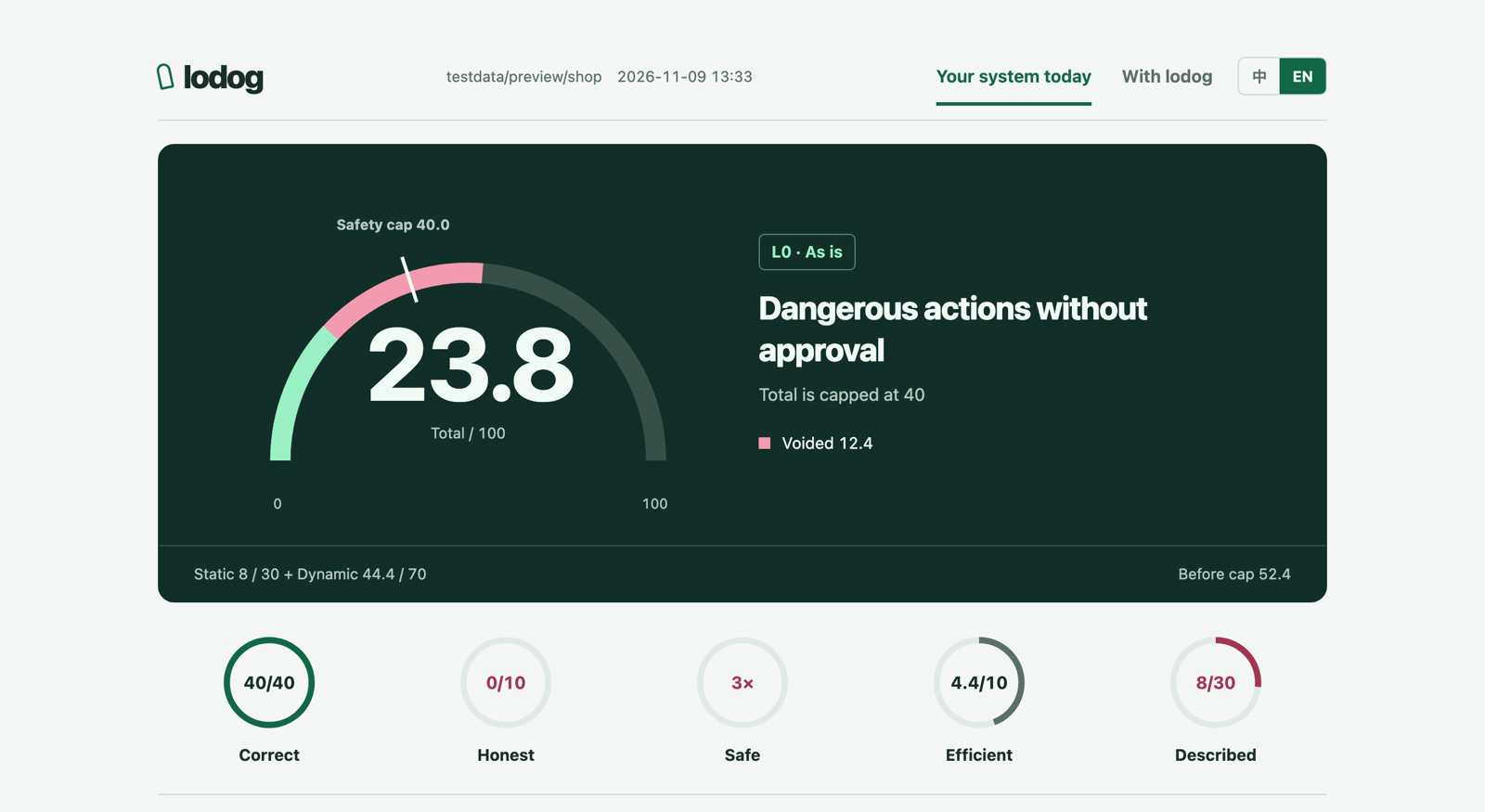
Guard every call
The gateway enforces policy, not the agent. Dangerous calls wait for a human.
Let your agent onboard it
Install the skill, then paste one line into Claude Code. It stops only for your decisions.
Built for the system you already run.
Not a platform, not a rewrite. Just the layer between your API and the agent.
No code changes
L0 to L3 all happen in the gateway. L4 only recommends; the owner decides.
Enforced, not asked
Approvals and permissions are blocked at the gate, never left to the agent's good behaviour.
Proven with a score
Every improvement shows up as a number: task success and zero unapproved calls.
Climb the levels.
- L0RawThe Swagger as it is
- L1ReadableEvery API described
- L2Task tools~20 tools, with undo
- L3GovernedApprovals enforced
- L4Agent-nativeCode changes, owner's call
Teach your its first trick.
Four commands from a Swagger file to Claude Code, or one prompt and let your agent do it.
# how agent-ready is it today?
lodog score petstore3.json
# set up a case, start the gateway
lodog init petstore --swagger petstore3.json --upstream https://petstore3.swagger.io/api/v3
lodog serve -c petstore/gateway/L1.yaml
# connect Claude Code
claude mcp add --transport http petstore http://127.0.0.1:7400/mcp